
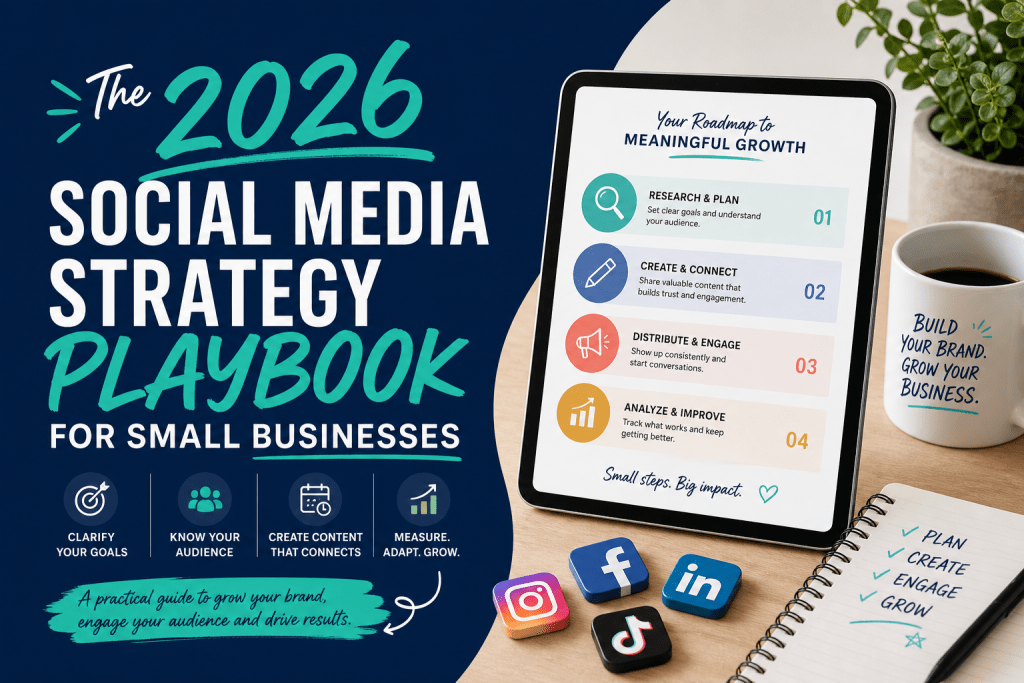
Every year brings a new round of predictions about social media strategy. Which platforms are dying, which formats are taking over, and which businesses are going to be left behind. 2026 is no different. Short-form video is still dominant. AI-generated content is flooding every feed. Organic reach on most platforms has continued to tighten. And small businesses are still trying to figure out how to compete without a full-time marketing team.
What hasn’t changed is the underlying logic of what makes social media work for a business. Consistency matters more than volume. Specific beats generic. Content that serves your audience compounds over time. And social media that isn’t connected to a website, an email list, and a broader marketing system will always underperform relative to what it could be doing.
This playbook is built around both realities. The shifts that are genuinely shaping 2026 and the fundamentals that were true in 2022 and will still be true in 2028. If your social media has felt more like a chore than a growth channel, this is a practical guide to changing that without starting from scratch.
Audit Before You Plan: Know What You’re Starting With
The first step in any honest social media strategy isn’t picking a platform or a content format. It’s looking at what you’re already doing and deciding what’s worth keeping.
Pull up your analytics on every active platform and ask a few direct questions. Which posts drove link clicks or profile visits, not just likes? Which content topics generated comments or shares from people who look like your actual customers? What’s your follower growth trend over the last six months? Is social appearing anywhere in your website traffic sources?
If you don’t know the answers to those questions, that’s the starting point. You can’t build a smarter strategy on top of activity you haven’t measured. Most small business owners are surprised when they do this exercise. Because the content that performed best often wasn’t what they expected. A behind-the-scenes photo outperforms a polished graphic. A direct question gets more responses than a promotional post. The data usually tells a story that your instincts alone wouldn’t have written.
At Hill Country Coders, we regularly do this kind of audit as part of our onboarding process with new clients, and it almost always reveals quick wins that were sitting right there in plain sight.
Platform Priorities for the 2026 Social Media Strategy Playbook
Platform dynamics have shifted meaningfully over the past year, and where you focus your energy in 2026 should reflect that. Here’s an honest read on where each major platform stands for small businesses right now.
Facebook has aged into a different role than it played five years ago. But it’s far from irrelevant. For local service businesses and community-rooted brands, Facebook Groups, local recommendations, and event promotion still drive real results. Its advertising platform remains the most powerful local targeting tool available. Particularly for businesses with a defined geographic service area.
Instagram is still essential for visually driven businesses, but the algorithm strongly favors Reels over static posts now. If you’ve been relying on photo posts alone, you’re likely seeing your reach erode. A mix of short-form video, Stories for daily engagement, and occasional static posts for evergreen content is the formula that’s working in 2026.
LinkedIn has become the highest-value organic platform for B2B businesses and professional services. Personal posts from business owners consistently outperform company page posts. Which means showing up as a person with genuine expertise carries more weight than broadcasting from a logo. If you sell to other businesses or to professionals making considered decisions, LinkedIn deserves a serious investment of time.
TikTok continues to reward authentic, personality-driven content with extraordinary organic reach for accounts willing to post consistently. The uncertainty around TikTok’s regulatory future in the U.S. makes it a secondary rather than primary investment for most small businesses. But it’s still worth maintaining a presence if short-form video is natural for you.
Pinterest remains an undervalued long-form traffic driver for businesses in home, food, lifestyle, wedding, and retail categories. Unlike every other social platform, Pinterest content compounds in value over time rather than dying after 48 hours. A well-optimized pin can drive traffic for two or three years. Which makes it one of the best investments for e-commerce and content-heavy businesses.
Sprout Social’s 2025 Social Media Trends Report provides detailed data on platform engagement trends and where audiences are migrating, and it’s worth reading in full before you finalize your platform priorities.
Content Strategy: The Posts That Actually Build Your Business
One of the biggest shifts in what works on social media in 2026 is the collapse of purely promotional content. Audiences have developed a finely tuned sense for posts that exist only to sell something, and they scroll past them without a second glance. What earns attention now is content that gives something first, whether that’s useful information, an honest perspective, a behind-the-scenes look, or a specific answer to a question your audience is actually asking.
The content mix that consistently performs well for small businesses in 2026 looks something like this. Educational posts that answer real questions your customers have drive the most saves and shares, which signals value to the algorithm and extends your reach. Behind-the-scenes and process content builds trust by showing the humans behind the brand. Client results and social proof convert interested followers into inquiries. Personality and opinion posts build loyalty and differentiate you from competitors saying all the same things.
What connects all of these is that they’re written or filmed for a specific person with a specific problem, not for a general audience. We covered this in detail in our article on why your social media isn’t driving leads, but the core principle is worth repeating: specificity converts, and generality scrolls.
According to the Content Marketing Institute’s 2025 research, educational and informational content continues to outperform promotional content on every major platform in terms of engagement, reach, and downstream conversion.
How Video Fits Into Your 2026 Social Media Strategy Playbook for Small Businesses
Video is no longer optional for businesses that want meaningful organic reach on most major platforms. That’s a sentence a lot of small business owners don’t want to hear, but the data is unambiguous. Instagram, Facebook, LinkedIn, and TikTok all prioritize video content in their algorithms, and the gap between the reach of a video post and a static post has widened every year.
The good news is that the bar for what “good enough” video looks like has actually lowered. Polished, produced video performs well in paid advertising contexts, but for organic social content, authentic and consistent beats high-production and sporadic. A 60-second iPhone video of you explaining a common question your customers ask will outperform a studio-shot promotional clip in almost every organic context.
If getting on camera feels like an obstacle, start small. Film yourself answering one frequently asked question per week. Show a project in progress. Walk someone through a process. Over time, what feels uncomfortable becomes routine, and the library of video content you build becomes one of your most valuable marketing assets. Buffer’s guide to social media video strategy is a practical starting point if you want a step-by-step framework for getting started without expensive equipment.
The 2026 Social Media Strategy Playbook for Small Businesses Requires a Real Content Calendar
Consistency is the most unsexy part of social media strategy and the part that matters most. Businesses that post when they feel like it and go silent when things get busy will never see the compounding results that come from a platform rewarding sustained, predictable activity.
A content calendar doesn’t need to be complicated to be effective. It needs to answer three questions: what are you posting, on which platform, and on which days? For most small businesses with limited time, committing to three to four posts per week on one primary platform is far more sustainable and effective than attempting daily posts across five platforms.
Batching content creation is the habit that makes this work in practice. Instead of trying to think of something to post every day, block a few hours at the start of each month to map out your topics, write your captions, and gather or create your visuals. That one session produces four weeks of content and removes the daily decision fatigue that causes most social media plans to fall apart by week three.
Your content calendar should also reflect the sales rhythm of your business. If you have a slow season or a promotional period, plan your content around that reality rather than posting randomly and hoping something lands at the right time. CoSchedule’s social media planning templates are a practical free resource for getting this system set up without overcomplicating it.
Connecting Social to Your Website and Email List in 2026
No social media strategy playbook is complete in 2026 without a clear plan for how social feeds your owned channels, specifically your website and your email list. Platforms change their algorithms, reduce organic reach, and occasionally get regulated out of markets. Your email list and your website are the two assets you control completely, and social media’s most important job is to grow both of them over time.
This means at least a portion of your content should actively drive people to a resource on your website, whether that’s a blog post, a free guide, a pricing page, or a contact form. It also means having a clear, ongoing reason for people to join your email list, whether that’s a checklist, a discount, access to exclusive content, or a simple promise of genuinely useful regular communication.
We’ve covered the mechanics of how these channels work together in detail in our articles on how all your digital marketing channels should work together and how to choose the right social media platform for your business growth. The short version: social media that feeds a website that captures emails is a system that builds value over time. Social media that exists only on the platform it lives on is a rented audience you can lose overnight.
Measuring What Matters: The Metrics That Tell the Real Story
A 2026 social media strategy playbook is only as useful as your ability to tell whether it’s working. That means getting specific about the metrics you’re tracking and honest about what they actually indicate.
Follower growth is a lagging indicator and a weak one. Likes and impressions tell you about reach but not about business impact. The numbers that actually connect to revenue are link clicks, website sessions attributed to social in Google Analytics 4, email signups driven by social campaigns, and direct messages or form submissions from people who found you through a social channel.
Set a baseline on those metrics before you make strategic changes, then measure against that baseline at 30, 60, and 90 days. If the numbers aren’t moving after 90 days of consistent, intentional effort, something in the strategy needs to change, whether that’s the platform, the content type, the audience focus, or the call to action. Good strategy isn’t static. It responds to what the data is actually telling you.
Building Your Social Media Strategy Playbook: Where to Start This Week
The businesses that will see the most growth from social media in 2026 aren’t the ones with the biggest budgets or the most followers. They’re the ones that treat social as a system, connect it to the rest of their marketing, create content with a clear audience and purpose in mind, and show up consistently enough for the platform to understand who they are and who they’re for.
If you’re building that system from scratch, start with your website. A social strategy that sends people to a site that doesn’t convert is a strategy that will keep disappointing you regardless of how good the content gets. Our team builds websites that are designed from the start to receive social traffic, capture leads, and support the kind of integrated marketing that actually compounds over time. If you’re ready to build that foundation, we’d love to talk.
Hill Country Coders is a web design and digital marketing agency serving small businesses in Texas and beyond. We build websites that work hard and marketing strategies that hold together.