
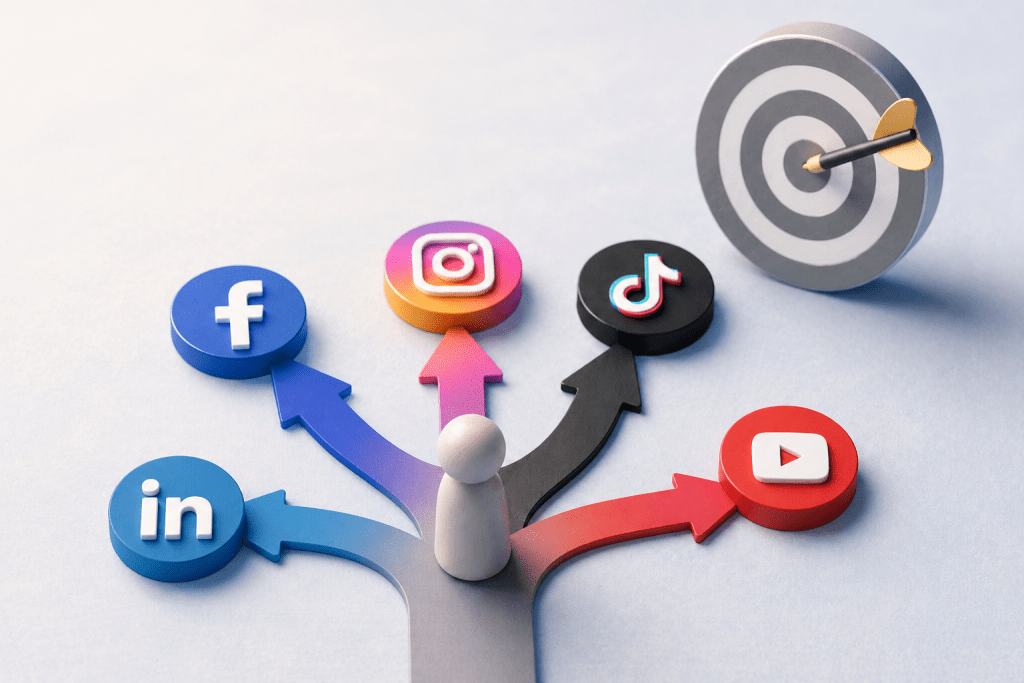
When a business decides it’s time to “get serious about social media,” the first instinct is often to set up accounts everywhere. Facebook, Instagram, LinkedIn, TikTok, Pinterest, X. The logic makes sense on the surface: more platforms means more reach, right?
In practice, it usually means spreading your attention so thin that nothing gets done well. A neglected profile with months-old posts and inconsistent branding can actually do more damage than no profile at all. It signals to potential customers that your business isn’t paying attention, and first impressions on social media are hard to walk back.
The businesses that grow through social media are almost always the ones that picked one or two platforms, committed to them, and built something real over time. Before you can do that, though, you have to figure out which platforms are actually worth your time. That decision should be driven by data and strategy, not by whatever platform happens to be getting buzz right now.
Start With Your Audience, Not the Algorithm
The single most important question when evaluating any social platform is straightforward: are your customers actually there? Everything else, including content formats, posting frequency, and ad capabilities, is secondary to whether the people you’re trying to reach are spending time on that platform.
Pew Research Center’s social media usage data breaks down platform demographics in detail, and the differences are significant. Facebook still skews older and has the broadest reach across age groups. Instagram leans younger and is heavily visual. LinkedIn is where professional and B2B audiences live. TikTok is dominant with users under 30. Pinterest over-indexes heavily with women, particularly in home, lifestyle, and retail categories.
This isn’t about stereotypes. It’s about where attention actually lives. If you run a B2B software company targeting operations managers at mid-size businesses, TikTok dance trends are probably not your fastest path to growth. If you own a wedding photography studio, LinkedIn is likely not where your next client is spending their Saturday afternoon. Match the platform to the people, and you’re already ahead of most of your competitors.
How to Choose the Right Social Media for Business Growth Based on Your Industry
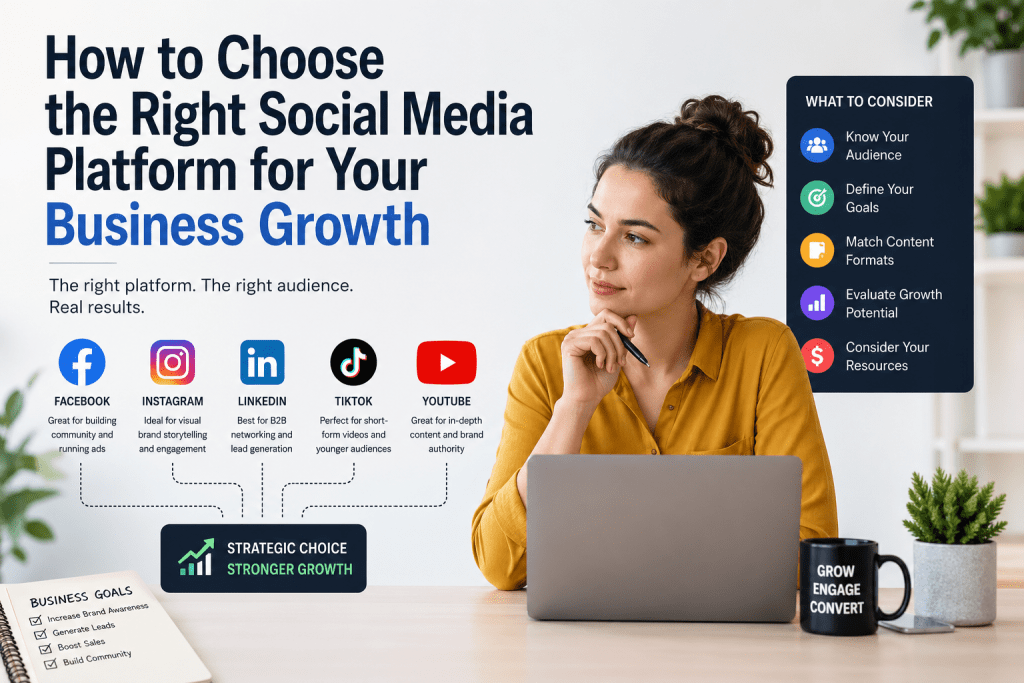
Industry context matters more than most marketing advice acknowledges. The platform that works brilliantly for a restaurant will often fall flat for a law firm, and vice versa. Here’s a honest look at which industries tend to find traction on each major platform.
Facebook remains the most versatile platform for local service businesses. Contractors, restaurants, retail shops, medical practices, and home service companies all do well here because the local targeting in Facebook’s ad platform is still the best available anywhere. Community groups and recommendations also drive meaningful organic reach for businesses with strong word-of-mouth reputations.
Instagram rewards businesses with a strong visual story. Restaurants, salons, fitness studios, interior designers, real estate agents, clothing boutiques, and photographers all have natural advantages here. If your work is photogenic or your brand has a clear aesthetic, Instagram is where it shows best.
LinkedIn is built for B2B businesses, professional services, and anyone selling to other businesses or career-minded professionals. Consultants, agencies, recruiters, SaaS companies, financial advisors, and executive coaches tend to find their most qualified leads here. Organic reach on LinkedIn for thoughtful, experience-based content still outperforms most other platforms.
TikTok has surprised a lot of business owners with its reach, particularly for brands willing to show personality and process. Trades businesses showing their craft, restaurants doing behind-the-scenes content, and consumer brands with strong storytelling have grown rapidly. The algorithm favors content over follower count more than any other platform, which gives newer accounts a real shot.
Pinterest is an underused channel for e-commerce, food, travel, home improvement, fashion, and wedding-related businesses. Because Pinterest functions more like a visual search engine than a social network, content has a much longer shelf life than posts on other platforms, and a well-optimized pin can drive traffic for years.
Match the Platform to the Type of Content You Can Actually Produce
This is where a lot of social media plans fall apart. A business chooses a platform based on where their audience is, then realizes they can’t consistently produce the kind of content that platform rewards.
TikTok and Instagram Reels demand short-form video, ideally filmed with personality and edited with some basic technique. If the idea of appearing on camera makes you want to close this tab, that’s information worth having before you invest months building a presence there. LinkedIn rewards long-form written posts and thoughtful commentary, which suits some business owners naturally and feels like pulling teeth for others. Instagram demands a steady stream of quality visuals, which is easy for a restaurant and harder for an accounting firm.
The best social media for business growth is the one where your audience lives and where you can produce content consistently without burning out in three weeks. Consistency over time beats any single piece of viral content, and according to Sprout Social’s research, brands that post on a reliable schedule see meaningfully higher engagement rates than those that post in bursts.
At Hill Country Coders, we help clients think through this honestly before building a social strategy, because the right answer is different for every business.
Consider Your Sales Cycle When Choosing the Right Social Media Platform for Your Business Growth
Not all businesses sell the same way, and different platforms support different parts of the buying journey. A platform that’s excellent for building awareness may be less effective at driving purchase decisions, and knowing where your customers are in their decision-making process should shape where you invest.
For businesses with a short, transactional sales cycle, like a local restaurant or a retail shop, platforms that support impulse and discovery work well. Instagram and Facebook’s combination of visual appeal, location targeting, and easy conversion tools (including direct booking or shop integrations) align naturally with how those purchases happen.
For businesses with longer, trust-driven sales cycles, like a financial advisor, a law firm, or a web design agency, the platform needs to support relationship-building over time. LinkedIn and email work hand in hand here, and we’ve written about how email and social media complement each other in our guide to integrated digital marketing.
For e-commerce businesses, the calculus includes not just where customers discover products but where they’re most likely to click through and buy. Meta’s own advertising data consistently shows strong ROAS for product-based businesses using Instagram and Facebook Shopping, particularly when campaigns are layered with retargeting.
Don’t Ignore Where Your Competitors Are Having Success
Competitive research is one of the most underused tools in social media strategy. Before you commit to a platform, spend time looking at what other businesses in your space are actually doing, and more importantly, what seems to be working for them.
Look at engagement rates, not just follower counts. A business with 3,000 highly engaged followers on LinkedIn is doing far better than one with 20,000 Instagram followers who never comment or share. Tools like Semrush’s social media tracker let you analyze competitor performance across platforms and identify where the real engagement is happening in your industry.
This research also helps you spot gaps. If every competitor in your space is posting on Instagram but no one has built a real presence on LinkedIn or Pinterest, you may have a window to establish authority in a less crowded space. Being third-best on a saturated platform is often less valuable than being first on one that fits your audience and has room to grow.
How to Choose the Right Social Media for Business Growth Without Wasting Time
The decision framework isn’t complicated, but it does require honesty about your resources, your audience, and your capacity. Here’s how to work through it:
- Identify where your specific customers spend time. Not their general demographic, but your actual customers. Ask them. Look at where your referrals come from. Check your website analytics for social traffic sources.
- Audit the content you can realistically produce. If you can write well, LinkedIn and Facebook are natural fits. If you’re comfortable on camera, video-first platforms make sense. If you have strong visual assets, Instagram or Pinterest may be your lane.
- Pick one primary platform and one secondary platform. Start there. Commit to a 90-day test with consistent posting before you evaluate whether it’s working.
- Connect your social activity back to your website. Every profile, every post that makes sense to do so, should have a clear path back to a page on your site that can capture a lead or make a sale. Social media that doesn’t eventually drive someone to your website is hard to measure and harder to grow from.
If you’re building or rebuilding your website and want it to be genuinely set up to receive social traffic and convert it, our team at Hill Country Coders builds sites designed specifically for that kind of integration. You can see more about how we approach website design for small businesses on our site.
The Platform Is Just a Starting Point
Choosing the right social media for business growth is an important first step, but it’s only a step. Once you’ve made a decision about where to show up, the real work is building a presence that reflects your brand accurately, speaks to your audience’s actual concerns, and gives people a reason to follow you, engage with you, and eventually hire or buy from you.
That means thinking about what you have to say that’s genuinely useful or interesting to your audience, how often you can show up without sacrificing quality, and how social media fits into the larger picture of your marketing. Social doesn’t work in isolation from your website, your SEO, your email list, or your reputation. It works best as one well-connected piece of a system built around your business goals.
If you’re ready to stop guessing and start building a social media presence that actually supports your growth, we’d love to talk. We work with small businesses across Texas to build marketing strategies that are specific, realistic, and designed to compound over time.
Hill Country Coders is a web design and digital marketing agency serving small businesses in Texas and beyond. We build websites that work hard and marketing strategies that hold together.