
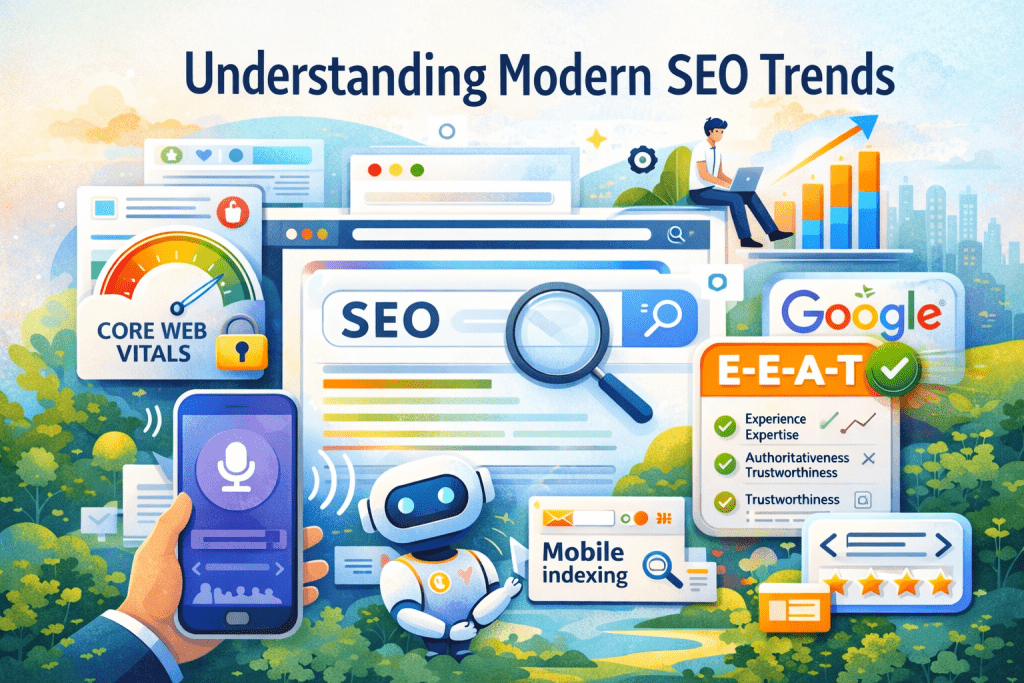
Modern SEO Trends continue to evolve as search engines refine algorithms and user behavior shifts. Businesses that stay informed and adapt to these changes maintain visibility, improve rankings, and strengthen digital authority. SEO is no longer just about keywords. It now involves technical performance, user experience, mobile optimization, content credibility, and emerging technologies such as voice and AI search.
Understanding Modern SEO Trends helps companies build sustainable organic traffic instead of relying solely on paid advertising.
Core Web Vitals and User Experience with Modern SEO Trends
One of the most significant Modern SEO Trends is Google’s emphasis on Core Web Vitals. These performance metrics evaluate how users experience a website, focusing on:
Largest Contentful Paint (loading speed)
First Input Delay or Interaction to Next Paint (responsiveness)
Cumulative Layout Shift (visual stability)
Google prioritizes sites that load quickly, remain visually stable, and allow smooth interaction. Improving these metrics enhances both search rankings and user satisfaction.
To optimize for Core Web Vitals:
Compress and optimize images
Minimize JavaScript and CSS files
Use reliable hosting
Implement caching
Monitor performance regularly
Google’s PageSpeed Insights tool can help analyze performance.
Mobile-First Indexing
Mobile-first indexing remains one of the most important Modern SEO Trends. Since most searches occur on mobile devices, Google primarily evaluates the mobile version of a website when determining rankings.
Businesses must ensure:
Responsive design across devices
Fast mobile load times
Readable fonts and spacing
Easy navigation and tap-friendly buttons
Failure to optimize for mobile negatively impacts both rankings and user trust. Mobile usability is no longer optional. It is foundational to SEO success.
Voice Search and Conversational Queries with Modern SEO Trends
Voice search continues to reshape keyword strategy. As digital assistants such as Siri, Alexa, and Google Assistant grow in popularity, users phrase searches conversationally.
Instead of typing “best digital marketing agency,” users might ask, “What is the best digital marketing agency near me?”
To align with Modern SEO Trends in voice search:
Focus on long-tail keywords
Answer common questions clearly
Structure content with FAQs
Optimize for featured snippets
Include natural language phrasing
Content that mirrors how people speak improves visibility in voice-driven results.
E-E-A-T and Content Authority
Google now emphasizes Experience, Expertise, Authoritativeness, and Trustworthiness, often referred to as E-E-A-T. High-quality, well-sourced, and accurate content performs better in search rankings.
To strengthen authority:
Publish in-depth, researched content
Cite credible external sources
Highlight author expertise
Earn backlinks from reputable websites
Maintain consistent content updates
Demonstrating credibility signals to search engines that your website is a trusted resource.
Google’s Search Quality Guidelines outline these standards:
AI and Search Intent Optimization
Artificial intelligence is transforming search behavior. Google’s AI-driven systems now prioritize understanding search intent over simple keyword matching.
Modern SEO Trends emphasize:
Topical authority
Semantic keyword clustering
Comprehensive content coverage
User-focused answers
Instead of targeting isolated keywords, businesses should build content around complete topic ecosystems.
Structured Data and Rich Results with Modern SEO Trends
Structured data markup enhances search visibility by enabling rich results such as:
FAQ snippets
Product reviews
Event listings
How-to guides
Implementing schema markup improves click-through rates and increases visibility within search results.
The Importance of Continuous SEO Adaptation
SEO is not static. Algorithm updates occur frequently, and user behavior continues to evolve. Businesses that monitor analytics, refine content, and prioritize performance maintain long-term search visibility.
Successful adaptation involves:
Regular content audits
Technical SEO improvements
Competitor analysis
Performance tracking
Continuous optimization
Modern SEO Trends reward businesses that prioritize user experience, credibility, and strategic content planning.