
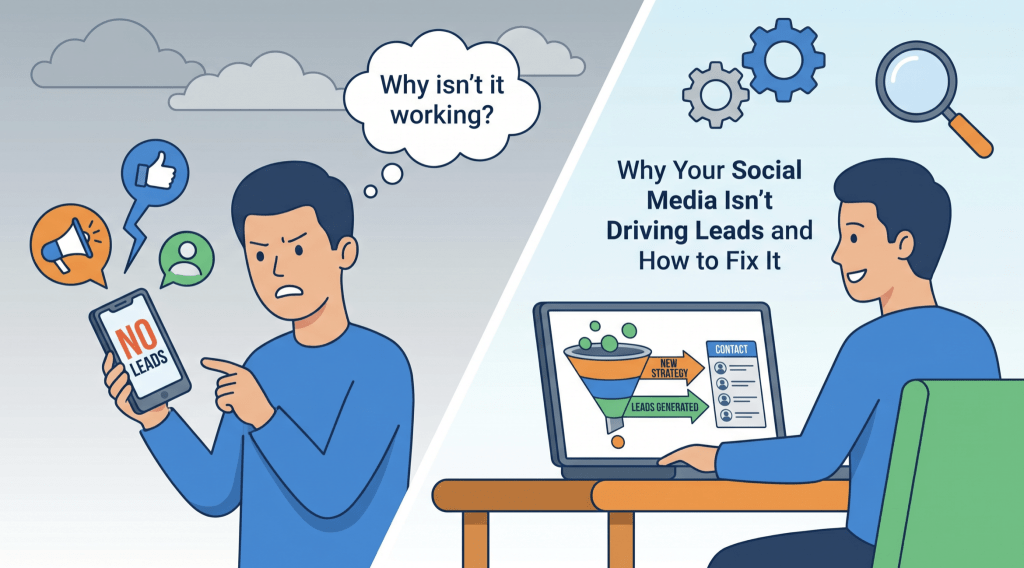
A lot of small business owners are doing the work. They’re posting regularly, responding to comments, and watching their follower counts inch upward. But when it comes time to ask where the leads are coming from, social media rarely makes the list.
This is one of the most common frustrations we hear from business owners who come to Hill Country Coders. They’re just not seeing a return from social media. And after months of effort, that starts to feel like proof that social media doesn’t work.
Usually, that’s not the real problem. The real problem is a gap between what social media is being asked to do and how it’s actually being used. Fixing that gap doesn’t require more posts or a bigger budget. It requires a clearer understanding of why the machine isn’t converting, and then making targeted adjustments that give the whole thing a direction.
Reason One: You’re Creating Content Without a Destination
The most common reason your social media isn’t driving leads is that your content has nowhere to send people. A post that gets likes and comments is doing something, but if there’s no next step for an interested viewer to take, that engagement evaporates. The person who thought “oh, I should look into this” scrolls on, forgets, and never comes back.
Every piece of social content you publish should have a job. Sometimes that job is pure awareness, which is fine. But at least a portion of your content should be actively moving people somewhere. Like a blog post that goes deeper on the topic. A landing page with a free resource. A contact page or a booking link. The call to action doesn’t have to be aggressive to be effective. A simple “we wrote more about this on our blog” or “we’re taking on new clients this month, link in bio” is enough to open a door that would otherwise stay closed.
Your website is where that door leads. This is why the connection between your social profiles and your site matters so much. If someone clicks through from Instagram and lands on a slow, confusing homepage with no clear next step, the lead is lost even though the social post did its job. We build websites specifically to receive that traffic and convert it. And you can learn more about that approach on our web design page.
Reason Two: Your Profile Isn’t Doing the Work It Should
Another reason your social media isn’t driving leads is because the profile is an afterthought rather than a sales asset. Before anyone sees your posts, they see your profile.
Your bio has a few seconds to answer three questions. What do you do? Who do you do it for? And what should someone do next? Most business bios answer the first question vaguely, skip the second entirely, and bury the third somewhere in a link that goes to a homepage with no clear focus. That’s a lot of friction at exactly the moment when someone is most curious about you.
A strong profile includes a clear, specific description of your service and who it’s for. It includes a link that goes somewhere intentional. Whether that’s a landing page, a lead magnet, a scheduling tool, or a specific service page. And it includes some form of social proof if the platform allows it. Whether that’s a highlighted review, a pinned post with a client result, or a featured link to a case study.
According to Hootsuite’s research on social media optimization, businesses that treat their profiles as conversion assets rather than directories consistently outperform those that don’t. It’s one of the lowest-effort, highest-leverage fixes available, and most accounts haven’t made it.
Reason Three: Why Your Social Media Isn’t Driving Leads When You’re Talking to Everyone
If your content is designed to appeal to everyone, it will resonate with almost no one. This is one of the harder truths in social media marketing, especially for business owners who worry that being too specific will shrink their audience. In reality, the opposite is true.
Content that speaks directly to a specific problem, a specific type of customer, or a specific situation consistently outperforms broad, generic posts. “We offer high-quality web design services” generates far less engagement and trust than “here’s why most service business websites lose leads before the phone even rings.” The second one is talking to someone specific about something specific. The right person reading it feels seen, and that’s what drives action.
This specificity extends to your imagery, your tone, your examples, and the problems you reference. A commercial contractor and a wedding photographer both “work with clients,” but the content that resonates with someone planning a commercial build is nothing like what resonates with someone planning a wedding. The more precisely your content reflects the world of your actual target customer, the more likely they are to engage, follow through, and reach out.
If you’re not sure who you’re talking to, that’s worth solving before you write another post. Our guide to building a digital marketing strategy for small businesses walks through how to define your audience in a way that shapes every channel, including social.
Reason Four: You’re Optimizing for Vanity Metrics
Follower count. Likes. Reach. These numbers feel meaningful because they go up and down in visible ways, and platforms are designed to make you care about them. But for a small business trying to generate actual leads, they’re mostly noise.
The metrics that actually matter are the ones connected to business outcomes. Link clicks, profile visits, website sessions from social, and direct messages that turn into conversations. A post that gets 200 likes and zero link clicks did less for your business than a post that got 12 likes and sent 40 people to your website.
Meta’s Business Help Center provides detailed breakdowns of outcome-focused metrics in their ad reporting. And the same logic applies to organic content. Start measuring what moves people from passive scrolling to active interest, and you’ll quickly see which content formats, topics, and calls to action are actually working versus which ones just feel good to post.
Shifting your attention from vanity metrics to conversion metrics also changes what you create. You stop chasing the post you think will go viral and start creating content that speaks clearly to the people most likely to become customers.
Reason Five: Social Media Is Not Driving Leads Because It’s Disconnected From the Rest of Your Marketing
Social media rarely converts on its own. Most people need multiple touchpoints with a brand before they make an inquiry, and if social is the only place you’re showing up, you’re asking it to do all of that trust-building work by itself. That’s a heavy lift, and most platforms aren’t designed for it.
The businesses that generate consistent leads are almost always the ones where social is connected to a larger system. Their social content sends people to a website that captures emails. Those emails go into a nurture sequence that builds the relationship over time. Their blog content feeds the social calendar, which drives more traffic back to the site, which builds SEO authority. Each channel feeds the next.
We’ve covered this in detail in our article on how all your digital marketing channels should work together, but the short version is this: if social media feels like it’s underperforming, the fix is often not to do more on social. It’s to connect social to something else that can carry the relationship further.
HubSpot’s State of Marketing report consistently shows that businesses with integrated marketing strategies, where social, email, content, and website work in coordination, see dramatically higher lead conversion rates than those running each channel independently.
The Fix: A Practical Framework for Social Media That Actually Generates Leads
Changing results on social doesn’t require a complete overhaul, but it does require intention. Here’s a framework that addresses each of the issues above in a manageable sequence.
Audit your profile first. Before you publish another post, make sure your bio is specific, your link goes somewhere useful, and your pinned or featured content represents your best work and clearest offer.
Add a destination to every post. Even if it’s subtle, every post should have somewhere for an interested person to go. Build that habit into your content process.
Narrow your audience focus. Pick your top two or three customer types and create content specifically for each of them in rotation. Notice which content generates the most meaningful engagement, not just likes, and make more of that.
Track the metrics that connect to money. Link clicks, website sessions from social, and messages that open conversations. Set up Google Analytics 4 to track social as a traffic source so you can see what’s actually landing.
Connect social to at least one other channel. At minimum, use social to drive email list growth. Offer something genuinely useful in exchange for an email address, and let email do the longer-term nurturing that social isn’t built for.
Why Your Social Media Isn’t Driving Leads Is a Solvable Problem
Nothing in this list is mysterious or out of reach for a small business owner with limited time and budget. The gap between “posting and hoping” and “posting with a system” is mostly a strategic one. And the adjustments that close it are almost always simpler than people expect.
What it does take is a clear-eyed look at what’s actually happening right now, the willingness to change a few habits, and ideally a website that’s built to receive and convert the traffic social media is sending.
If you want a second set of eyes on your current social presence, our team is happy to help. We work with small businesses across Texas and beyond to close exactly this kind of gap.
Hill Country Coders is a web design and digital marketing agency serving small businesses in Texas and beyond. We build websites that work hard and marketing strategies that hold together.