
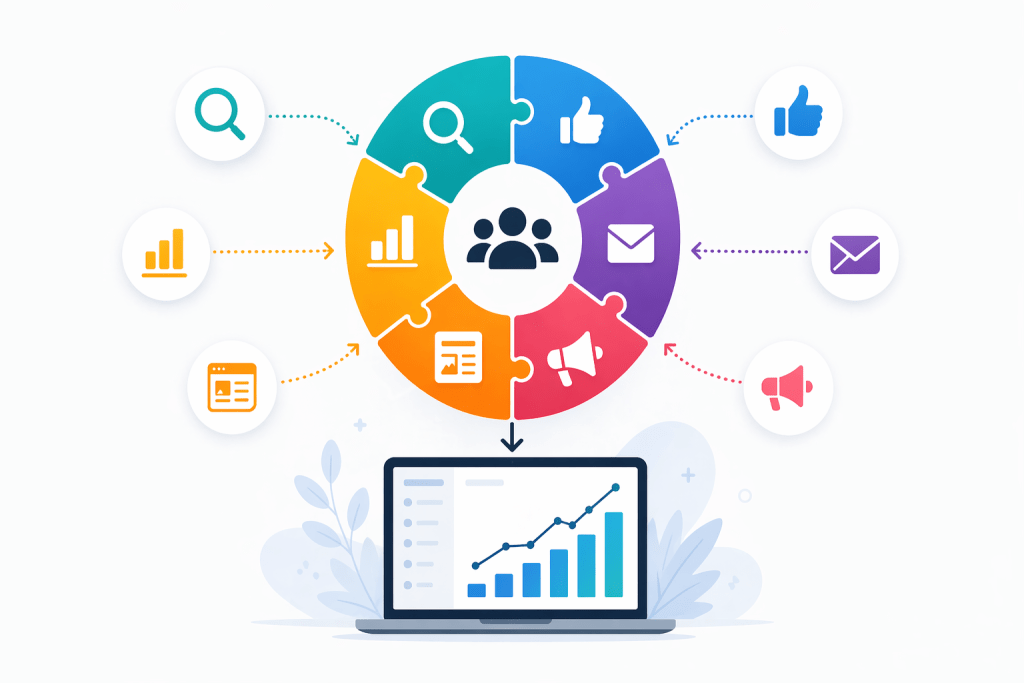
You post on Instagram. You send the occasional email newsletter. Maybe you run a Google ad when you feel like traffic is slow. Each of these things gets done, checked off, and forgotten until next time. Sound familiar? This is the most common pattern we see when working with small businesses on their digital presence, and it’s also the most expensive habit to maintain. When your digital marketing channels operate independently of each other, you’re essentially paying for the same customer’s attention multiple times instead of guiding them through a single, connected experience.
The difference between a business that “does marketing” and one that grows consistently usually comes down to one thing: integration. When your channels reinforce each other, every dollar you spend works harder and every piece of content travels further.
What It Actually Means for Your Digital Marketing Channels to Work Together
Integration isn’t just a buzzword. In practical terms, it means your audience can start their journey with your brand anywhere and end up in the same place: becoming a customer.
Think about how a well-coordinated campaign actually flows. A potential customer sees a Facebook post about a blog article you wrote. They click through, read it, and find it useful. A few days later, they search Google for a related question and your website appears because that blog post was well-optimized. They visit again, sign up for your email list, and then receive a welcome sequence that speaks directly to the problem that brought them to you in the first place.
That’s not magic. That’s a system where each channel knows its role:
- Content/SEO attracts people who are actively searching
- Social media builds awareness and drives traffic to that content
- Email nurtures the relationship once someone has shown interest
- Paid advertising accelerates what’s already working organically
- Your website ties it all together and converts visitors into leads
None of these channels is doing the other’s job. They’re each playing a distinct position, and together they form something much more effective than any one of them alone.
Start With Your Website as the Hub
Before anything else, your website needs to be the foundation that every other channel points back to. A social media profile you don’t own. An email service provider can change its pricing. A Google ad stops working the moment your budget runs out. Your website is the one asset you control completely.
That means your website needs to be fast, clear about what you offer, and built to capture leads even from first-time visitors. If someone arrives from an Instagram story and your homepage takes five seconds to load or buries your contact information, that channel just failed regardless of how good the ad was.
At Hill Country Coders, we build websites specifically designed to serve as that hub, with landing pages, lead capture forms, and clear calls to action that work whether someone is arriving from search, social, or email. The website isn’t just a brochure; it’s the engine your whole marketing machine runs on.
How SEO and Content Marketing Feed Every Other Channel
One of the most underrated investments a small business can make is in consistent, well-optimized content. A single blog post that ranks for a relevant keyword doesn’t just bring in search traffic once. It gives you something to share on social media, something to link to in an email campaign, and a foundation for a paid retargeting campaign targeting people who already read it.
According to HubSpot’s research, businesses that blog regularly generate significantly more leads than those that don’t, and much of that lift comes not from the blog itself but from the compounding effect it has on every other channel.
When you write a post that answers a real question your customers are asking, you’re creating an asset. Good SEO practices, including proper keyword targeting, internal linking, and a fast-loading page, ensure that asset gets found. But the real power comes when you use that post as a jumping-off point for your email newsletter, your social posts that week, and even the ad copy you use to retarget site visitors.
Social Media’s Real Job in Your Marketing Mix
A lot of businesses treat social media as a place to post and hope. The algorithm rewards consistency, but consistency alone won’t build a business. Social media’s real job in an integrated strategy is to create awareness and push warm audiences toward deeper engagement, usually your website or email list.
This means your social content should have direction. Instead of posting for the sake of posting, each piece of content should either educate your audience (and link to something that goes deeper), build trust through social proof, or invite people into a conversation that moves them closer to a decision.
Sprout Social’s 2024 data shows that the majority of consumers will visit a brand’s website after following them on social, which means your social presence is essentially a warm-up act for your website. The hand-off between those two channels has to be intentional.
Email Marketing: The Channel That Closes the Loop
Email remains one of the highest-ROI channels available to small businesses, and it works best when it’s connected to everything else you’re doing. When someone downloads a resource from your website, reads your blog, or registers for an event, they should enter an email sequence that continues the conversation they started elsewhere.
This is where a lot of the “channel integration” actually happens in practice. Your email list knows what your audience has already engaged with, which means you can send content that’s genuinely relevant rather than blasting the same message to everyone.
A visitor who came to your site through a search for “website design for small businesses” is a different kind of prospect than someone who found you through a referral. When your CRM or email platform is connected to your website and tracks where people came from, your email marketing gets sharper and more personal. We cover more on this in our guide to building a digital marketing strategy for small businesses.
Paid Advertising Works Better When the Other Channels Are Strong
One of the most common mistakes we see is businesses turning to paid ads as a first resort when organic efforts haven’t taken off yet. Paid advertising is a powerful tool, but it amplifies what’s already there. If your website isn’t converting, ads will just deliver more people to a leaky bucket.
The smarter approach is to use paid ads to accelerate what’s already working. If a particular blog post is drawing organic traffic and converting visitors to leads, a paid campaign targeting a lookalike audience around that post can dramatically expand your reach. If your email list is growing steadily, a Facebook ad campaign targeting people similar to your subscribers is starting from a place of proven relevance.
Google’s own guidance on Performance Max campaigns makes this explicit: campaigns perform better when they’re fed strong creative assets, landing pages, and audience signals from your existing customer base. That data only exists if your other channels have been doing their work.
Making Your Digital Marketing Channels Work Together: A Simple Framework
If you’re ready to stop running digital marketing channels in isolation, the shift doesn’t require a complete overhaul overnight. It starts with asking one question about everything you publish: where does this lead, and what happens next?
Here’s a simple framework to think through:
- Every piece of social content should point somewhere, usually your website or a lead magnet
- Every blog post should be promoted via email and social, not just published and abandoned
- Every email should connect back to content or a conversion point on your website
- Paid ads should target audiences that have already interacted with your organic content
- Your website should capture information that helps you personalize future touchpoints
The goal is a closed loop where each channel feeds the next and no customer interaction falls through the cracks. When someone engages with your brand, that engagement should open a door to the next step, not lead to a dead end.
How All Your Digital Marketing Channels Work Together With the Right Partner
Building an integrated marketing system takes strategy, technical setup, and consistent execution. Most small businesses have the ambition but not always the bandwidth or expertise to wire everything together correctly. That’s where having the right team behind you makes a measurable difference.
At Hill Country Coders, we work with small businesses across Texas to build websites and marketing systems that are designed from the start to connect. That means sites built for SEO, integrated with your email platform, structured to support paid campaigns, and optimized to convert traffic from every channel you use.
If your marketing has felt more like a collection of disconnected tasks than a coherent system, it’s worth having a conversation about what a more connected approach could look like for your business. Reach out to our team and we’ll start with where you are.
Hill Country Coders is a web design and digital marketing agency serving small businesses in Texas and beyond. We build websites that work hard and marketing strategies that hold together.