
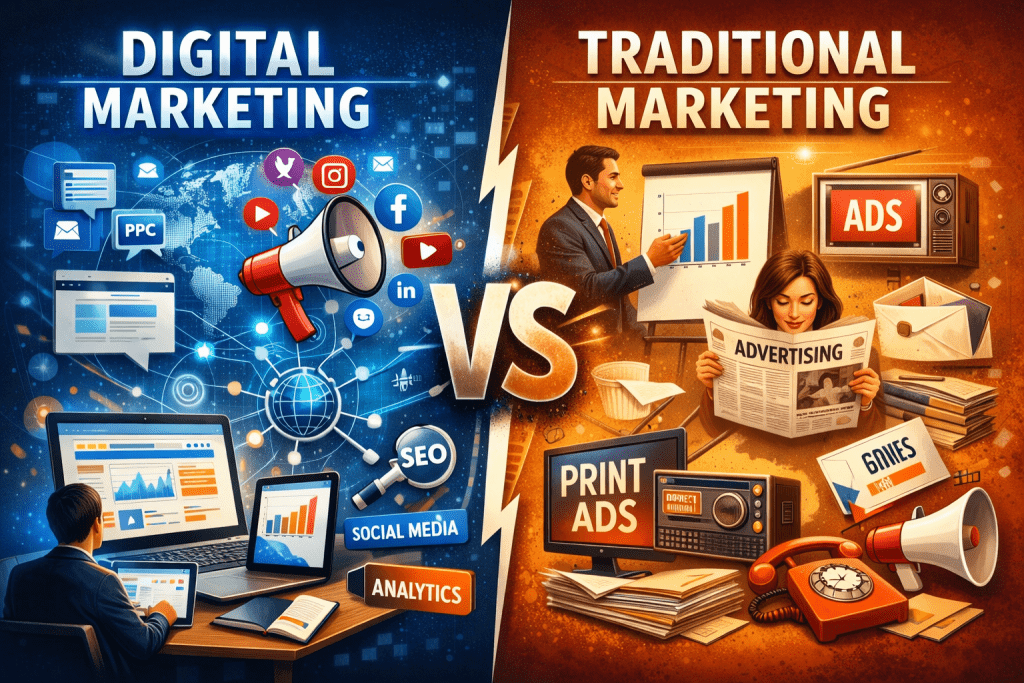
Every business owner faces the same question sooner or later: where do you put your marketing dollars? Traditional channels like TV, print, and billboards have built brands for decades. But digital marketing, search engines, social media, email, and content, now dominates how consumers discover and evaluate businesses. The answer between digital marketing vs traditional marketing isn’t always one or the other.
What is traditional marketing?
Traditional marketing refers to any promotional strategy that uses offline channels. This includes print advertising (newspapers, magazines, flyers), broadcast media (TV and radio commercials), direct mail, outdoor advertising (billboards, transit ads), and in-person events. These methods have been the backbone of brand building for over a century.
According to Statista, U.S. advertisers still spend tens of billions annually on television and print, proof that traditional media retains real reach, especially for local and older demographics.
What is digital marketing?
Digital marketing encompasses all marketing efforts conducted online. This includes search engine optimization (SEO), pay-per-click advertising (PPC), social media marketing, content marketing, email campaigns, and influencer partnerships. Digital channels allow businesses to reach audiences wherever they spend time online — and that’s a lot of time.
The DataReportal Global Overview shows that more than 5.4 billion people worldwide now use the internet, spending an average of nearly seven hours online per day. For most businesses, that’s an audience too large to ignore.
Digital Marketing vs Traditional Marketing: Head-to-head comparison
Let’s break down the key differences across the dimensions that matter most to your bottom line:
DIGITAL MARKETING
- Precise audience targeting
- Real-time analytics & ROI tracking
- Lower entry cost; scalable budget
- Two-way audience engagement
- Easily adjustable campaigns
- Global or hyper-local reach
TRADITIONAL MARKETING
- Broad, passive audience reach
- Difficult to attribute conversions
- High upfront production costs
- One-way communication
- Long lead times to change
- Strong local/regional credibility
63% of businesses plan to increase digital ad spend in 2025–26
$0.61 average cost-per-click for Google Ads across all industries
4,200% average ROI for email marketing ($42 return per $1 spent)
Cost: who wins on budget?
Traditional marketing often carries steep production and placement costs. A single 30-second local TV spot can run $1,500–$15,000+ to produce and air, while a full-page magazine ad can top $100,000 in national publications. Direct mail campaigns average $0.50–$3.00 per piece before postage.
Digital marketing, by contrast, lets you start small. A well-targeted Google Ads or Facebook campaign can begin for as little as $5–$10 per day. Our PPC management services help businesses of all sizes squeeze maximum return from every dollar spent, whether the budget is $500 or $50,000 a month.
Pro tip: Digital marketing’s biggest cost advantage is the ability to pause, adjust, or scale campaigns in real time based on what the data tells you. Traditional media rarely allows mid-campaign pivots.
Targeting: reaching the right people
Traditional marketing reaches broad audiences based on demographics tied to a medium, viewers of a particular TV show, readers of a regional paper, commuters on a highway route. It’s effective for mass awareness but imprecise by nature.
Digital marketing offers targeting depth that was unimaginable a generation ago. Platforms like Google, Meta, and LinkedIn let you target by age, location, income, interests, job title, past purchase behavior, and even life events. Think with Google research consistently shows that personalized, data-driven campaigns outperform generic ones on both engagement and conversion rates.
Measurability & ROI When Considering Digital Marketing vs Traditional Marketing
One of the most compelling arguments for digital marketing is accountability. Every click, impression, conversion, and customer journey touchpoint can be tracked. Tools like Google Analytics 4, Meta Ads Manager, and HubSpot give marketers granular insight into what’s working and what isn’t, in real time.
Traditional marketing has long relied on estimated reach (circulation figures, Nielsen ratings) rather than actual engagement. You know your ad ran; you rarely know exactly who saw it or whether it drove a sale. The Nielsen Advertising Effectiveness suite exists precisely because attribution in traditional media is genuinely hard.
If data-driven decision-making matters to your business, and it should, our marketing analytics services can help you build a clear picture of where every dollar goes and what it returns.
When traditional marketing still makes sense
Don’t write off traditional channels entirely. There are scenarios where they outperform digital alternatives:
Local brand visibility. A well-placed billboard or radio spot in a tight geographic market can build name recognition faster than months of social posts. This is especially true for service businesses such as plumbers, dentists, real estate agents, serving a specific city or neighborhood.
Older demographic audiences. If your core customers are 55+, television and print still capture their attention more reliably than digital ads. The Pew Research Center notes meaningful gaps in daily internet usage between younger and older Americans.
Event-based or experiential campaigns. Trade shows, sponsorships, and in-person activations create memorable brand impressions that no banner ad can replicate.
Trust and credibility signals. Being featured in a respected print publication can confer authority that digital ads sometimes lack, particularly for B2B and professional services audiences.
Why most businesses should prioritize digital in 2026
For the majority of small and mid-sized businesses today, digital marketing offers a superior combination of reach, precision, speed, and measurability. Consumer behavior has shifted decisively online: product research, service comparison, reviews, and purchasing decisions now begin, and often end, on a screen.
A strong digital foundation typically includes:
Search visibility: If people are searching for what you offer and you don’t appear on page one, you don’t exist to them. Our local SEO services are designed to put your business in front of high-intent customers in your market.
Social media presence: Platforms like Facebook, Instagram, and LinkedIn build community, trust, and repeat engagement at a fraction of traditional advertising costs.
Content marketing: Blog posts, videos, and guides attract organic traffic for months or years after publication, a compounding return traditional ads never provide. The Content Marketing Institutereports that content marketing generates three times more leads than outbound marketing at 62% less cost.
Email marketing: With an average ROI of $42 for every $1 spent, email remains one of the highest-performing digital channels available. Our email marketing campaigns are built to nurture leads and turn one-time buyers into loyal customers.
The smartest strategy: integration
The most effective modern marketing programs don’t choose sides, they integrate both worlds strategically. A contractor might run local radio spots to build brand awareness while also running Google Search ads to capture intent-driven leads the same day. A retailer might use direct mail to drive traffic to a landing page with a trackable discount code.
The key is understanding where your customers are in the buying journey, which channels reach them most effectively at each stage, and how to measure the result. That’s exactly the kind of holistic strategy we help clients build at Hill Country Coders.
Not sure where your business should invest? We’ll audit your current marketing mix and show you exactly where digital can deliver the biggest return. Get a free marketing consultation